Jacob Baxter
The North WaterJacob Baxter is the financier and organizer whose effort to turn a failing whaling venture into a profitable insurance scheme reaches from recruiting Patrick Sumner to the proposed loss of the Volunteer. He speaks of money as a force beyond anyone’s control, yet repeatedly acts to channel it: arranging employment, presenting financial papers, coordinating with Campbell, and offering to reshape the story after the disaster. His confidence in managing appearances fails when Sumner comes back alive with knowledge of the killings and the ship’s destruction.
Identity and Background
Baxter is established as a businessman encountered by Sumner in the bar of the Adelphi Hotel in Liverpool. Sumner is passing through on his way back from lawyers in Dublin, waiting for a case to be resolved and short of money. When Baxter learns that he is an ex-army surgeon seeking work, he recognizes an opportunity and connects him with the whaling voyage. The recruitment answers Sumner’s immediate need for employment while placing a medically trained witness aboard a ship whose owners and organizers have concealed purposes.
His dealings with Brownlee reveal the breadth of his commercial outlook. Brownlee regards Baxter as a sharp operator and distrusts him, while Baxter’s manner combines sustained talk with a lawyerly appearance rather than a mariner’s. He is depicted in carefully chosen clothes and as a man who, despite seeming unwell, continues to attend to business. The contrast matters: Baxter’s authority comes not from work at sea but from his ability to frame a venture, negotiate its terms, and argue that financial necessity determines what happens next.
Whaling, Decline, and the Financial Scheme
Baxter recruits Brownlee against the background of a declining whaling industry. He reminds the captain that an earlier generation could prosper with a boat and harpoon, recalling the Aurora’s return in June 1828 with a large load of whalebone. In the changed market, he argues, success requires powerful steam engines, harpoon guns, and luck, and even these may not bring a catch. He also points to petroleum and coal gas as substitutes for whale oil. Brownlee rejects the notion that the whales or the trade have run their course, insisting that skilled command and a capable crew can still fill the hold. Their disagreement sets Brownlee’s faith in whaling against Baxter’s willingness to treat its decline as a reason to move capital elsewhere.
The papers Baxter brings to Brownlee make the alternative concrete: twelve thousand pounds divided three ways, a sum he presents as far beyond the likely returns from killing whales. Brownlee responds by insisting that Campbell must be present when needed, and threatens to turn the ship back if he is not. Baxter, for his part, describes money as something that finds another passage when one is blocked, as if capital had its own direction and could not be governed by personal preference. This fatalistic account of money also serves as an argument for accepting the scheme he has arranged.
The Volunteer’s heavy and disproportionate insurance makes the plan vulnerable to scrutiny. Campbell warns Brownlee that the loss must look convincing and not provoke questions from the underwriters. The timing matters too: the ship must be sunk under circumstances that appear credible, without Campbell being trapped by the ice himself. Baxter’s financial design therefore depends not only on the insured vessel but on staging an apparently plausible loss. Later, Sumner directly accuses Baxter of having Cavendish sink the Volunteer, identifying the ship’s destruction as part of the conspiracy rather than an ordinary maritime accident.
The Voyage and Its Human Consequences
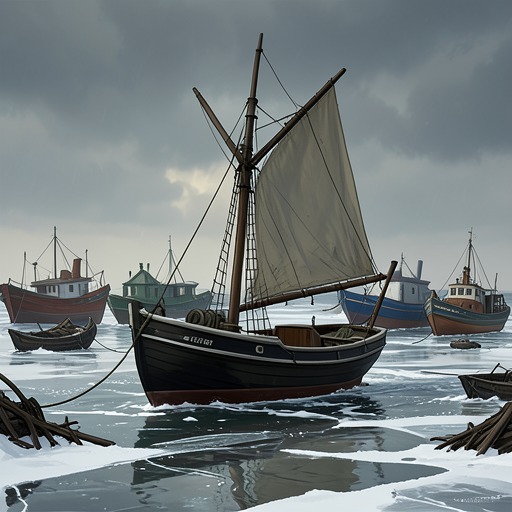
Baxter’s arrangement places Brownlee, Sumner, and the crew aboard a working whaler whose ordinary labor continues alongside the concealed plan. The men sail north through severe weather, hunt seals, and then pursue whales in the North Water. Brownlee counts the potential value of the catch and hopes for a profitable season; the crew’s work is physical, dangerous, and dependent on the ship’s condition and the ice. The commercial enterprise is not merely a cover in the sense of a false description: its real work and its real risks give the planned loss a setting in which disaster can appear credible.
As the voyage proceeds, the Volunteer becomes entangled with shipboard violence and death. After the murder of Joseph Hannah, Brownlee blames Baxter for choosing the crew and setting the unnatural scheme in motion, though this is Brownlee’s judgment rather than a confession by Baxter. The suspicion points to the moral cost of Baxter’s planning: he treats the voyage as an instrument of financial return, while its consequences are borne by people whose lives and labor are exposed to danger. When ice threatens the ships, the men cut an ice dock to protect the vessel. The work is a practical response to immediate peril, but it also creates a sharp contrast with the scheme’s underlying purpose. Drax observes that if the ship does not sink then, it can be sunk later, though the appearance would be less convincing after the effort to build the dock.
Return, Denial, and Countermeasures
Baxter’s control over the story falters when Sumner returns to Hull. After weeks away, Sumner arrives alive and meets Baxter at his chambers on Bowlalley Lane. Baxter greets him with astonishment and offers food, but Sumner senses wariness beneath the friendliness. Baxter had expected the surgeon to be dead or lost with the others; his survival makes him a person who can report what happened rather than a casualty whose account can be managed by others.
When Sumner raises the killings and the ship’s loss, Baxter initially advocates silence, arguing that the dead should be left undisturbed and describing the deaths as an accident. Sumner rejects that account, distinguishing accident from deliberate acts and reminding Baxter that he knows about the killings. Baxter calls the news horrifying, but his response does not resolve the accusation. In a later confrontation, Sumner sets out his theory: that Baxter arranged for the Volunteer to be sunk, with Drax and Sumner as the only people who might know or suspect the truth, and that a second planned killing was supposed to leave the matter neat. Baxter denies the account and turns instead to Sumner’s immediate danger, emphasizing that two men are dead in the timber yard and that Sumner killed one of them.
Baxter’s next moves show both his resources and his aim of containing the consequences. He checks the revolver and ammunition he has supplied to Stevens. Later, he opens his safe and gives Sumner a wallet containing fifty guineas, urging him to go to London, forget the Volunteer and Drax, and leave the past behind. He also offers to invent a story that will distract attention from the timber-yard deaths. Money, once more, is presented as a way to redirect events: the payment might buy Sumner’s departure and give Baxter room to manage the public account.
Reversal and Narrative Significance
Sumner does not accept Baxter’s proposed escape on Baxter’s terms. He takes control of the encounter, makes Baxter lead him to the stables, and binds him there, warning that he may be found alive in the morning if he stays calm. The reversal leaves Baxter alive at the end of the described episode, but no longer directing the movement of money, testimony, or other people. The man who had hired witnesses, calculated insurance, and offered a story to divert suspicion is physically restrained by the survivor whose return unsettled his plans.
Baxter’s role links the novel’s maritime danger to the financial arrangements behind it. His language about declining markets and unstoppable money gives commercial calculation the appearance of inevitability, while the plot shows that the scheme still requires choices: who is hired, when a ship is lost, what explanation is offered, and which witnesses are silenced or discredited. His effort to treat a vessel and its voyage as instruments of profit exposes the human risks concealed by that calculation. Sumner’s return is decisive because it makes the intended account of the loss contestable, and Baxter’s final loss of control turns the organizer’s own methods of leverage against him.